


How Pro-Conex Changes the Way You Run a Signal.
If you’ve ever taped down four XLR cables where one should do, pulled new wire through a wall that already had Cat6 in it, or lost a DMX universe mid-show because a connector vibrated loose — this is the guide for you.
The Idea: Replace Four XLR Runs with One Shielded Cat Cable
Professional XLR cable is great. It’s robust, universal, and every tech on the planet knows how to use it. The problem isn’t the cable — it’s running four of them everywhere. Four cables to route, four to tape, four connection points to check at show time, four things to chase at strike.
The Pro-Conex system doesn’t replace XLR at the gear. It replaces the trunk run between locations. A LittleCat (DFX-345) or DNX-300 breakout box sits at each end. The four XLR lines plug into the fan-out on each box. In between, a single shielded Cat cable carries all four channels. The connections at the gear stay exactly the same. What changes is everything in the middle.
The result is a slimmer run, fewer connection points to fail, and — critically — the ability to use infrastructure that’s already there. Shielded wall ports, existing conduit, in-ceiling Cat runs installed for networking and never used for audio. If that infrastructure is in the building, this system uses it.
Instead of running four separate XLR cables to your endpoint, you run one locking Cat6. A LittleCat or DNX breakout box sits at each end and fans out to your four individual channels. One locked connection in the middle that vibration, foot traffic, and road cases can’t pull free. And if the infrastructure is already there — shielded Cat in the walls, existing conduit — you’re using it instead of fighting around it.

The Backbone: Hosa EtherLOK Cat6 (ETC-100 Series)
The cable spec is not incidental here. The Hosa EtherLOK Cat6 uses SF/UTP construction — braid and foil shielding around all four twisted pairs. That shielding does two things that matter for this application: it blocks the EMI and RFI interference you’ll encounter near dimmer racks, moving light power supplies, and dense electrical environments; and it maintains the common ground that’s required when running +48V phantom power for condenser microphones.
The connector is equally important. The EtherLOK shell locks into Neutrik etherCON-compatible chassis connectors — the same locking mechanism used on the LittleCat and DNX boxes. A standard RJ45 can be kicked loose by a road case or pulled free by someone walking through a cable. The EtherLOK doesn’t release until you press the tab. On a stage floor or in a crowded rack, that difference is the difference between a signal you can trust and one you’re constantly checking.
| Specification | Detail |
|---|---|
| Series | ETC-100 |
| Connector | RJ45 with EtherLOK Locking Shell (Neutrik etherCON compatible) |
| Standard | Cat6 (Category 6), 250 MHz bandwidth |
| Conductors | 26 AWG x 4 twisted pairs, OFC |
| Shielding | SF/UTP — braid + foil |
| Outer Diameter | 6.2 mm (0.245″) |
| Jacket | Black PVC |
| Warranty | Hosa Lifetime Warranty |
Pro-Conex LittleCat (DFX-345) — Built for Close-Quarters Connections
The LittleCat is a galvanized steel breakout box with a 12-inch integrated XLR fan-out whip permanently attached. That detail matters: because the fan-out is built in, the LittleCat is designed to sit directly at the gear — plugged into a console input, tucked into a table cubby, or mounted at a wall plate. No separate patch cables. No additional infrastructure between the box and the equipment.
Two versions cover both ends of a typical run:
- DFX-345M (Male XLR fan-out): Plugs directly into the inputs of a mixing console, DSP, power amp, or any device with XLR female inputs. This is your “destination” end — the Cat cable comes in, four balanced signals go directly to your gear.
- DFX-345F (Female XLR fan-out): Accepts signals from microphones, DIs, or any XLR male source. This is your “source” end — four inputs consolidate into a single Cat cable run to wherever the signals need to go.
The LittleCat is passive and built tough — galvanized steel housing, integrated strain relief, no power required, no configuration, no drivers. Signal in, signal out.
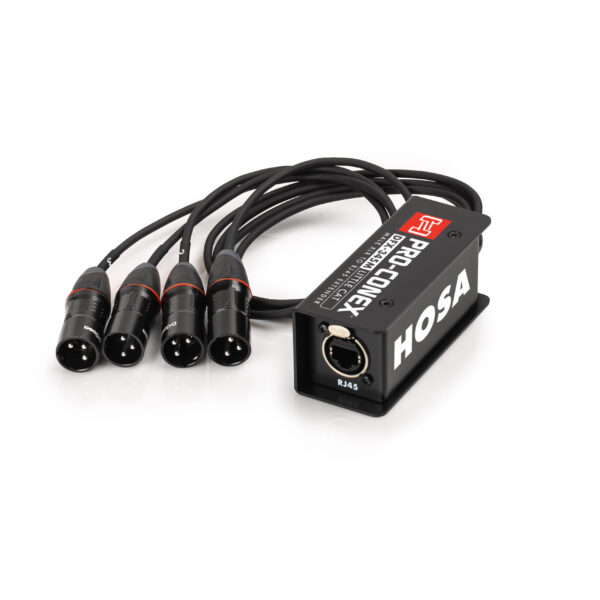
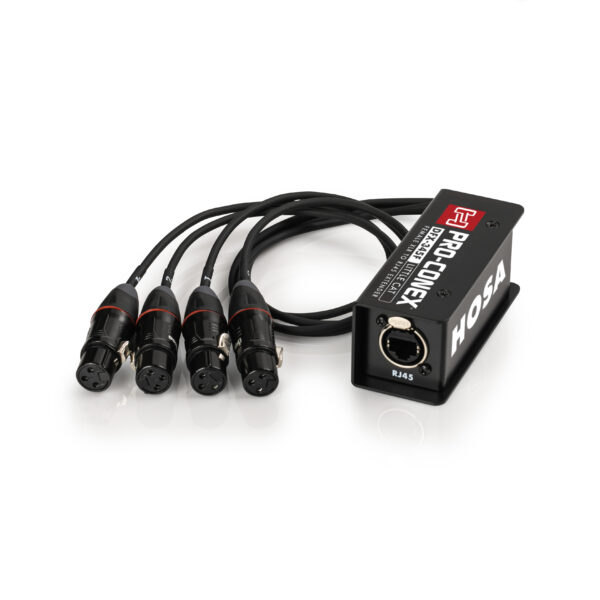
Pro-Conex DNX Series (DNX-345) — Built for Fixed Termination Points
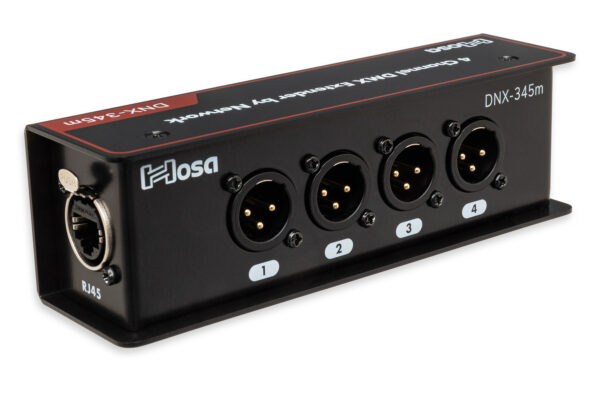
The DNX Series serves a different role. Where the LittleCat’s integrated whip is designed to terminate directly at gear, the DNX boxes are built for fixed positions — a stage floor termination point, a lighting truss, a permanent install location where the Cat cable arrives and XLR cables depart to individual fixtures or devices nearby.
The DNX-345 is specifically engineered for AES3 and DMX compliance, maintaining the 110-ohm impedance required for stable digital signal transmission. This matters for DMX in particular: analog audio is generally forgiving of impedance variation, but DMX data isn’t. If you’re running four universes over Cat, the DNX is the correct tool — not because the LittleCat won’t pass the signal, but because the DNX is built to the spec that DMX requires.
Like the LittleCat, the DNX uses locking RJ45 connectors on the Cat side, and it’s available in Male (XLR3M) and Female (XLR3F) configurations to match the direction of your signal flow.
The two product families also work well together in a mixed configuration: a DNX box on the stage floor or truss as a rugged fixed termination point, and a LittleCat in the rack or console cubby for a clean direct-to-gear connection at the destination. One EtherLOK trunk connects them. Each end uses the right tool for its environment.

Technical Note: This Is Analog Over Copper — Not a Network Solution
The Pro-Conex system uses Category-rated cabling as a physical transport medium, but it is a purely analog, passive pass-through. There is no network protocol involved — no Dante, no AES67, no ART-NET. Do not connect the LittleCat or DNX boxes to a network switch, router, or any active network infrastructure. Doing so will not work and may damage equipment.
- Shielded cable is required for phantom power. STP Cat5e, Cat6, or Cat7 only. Unshielded UTP cable lacks the common ground path required to safely pass +48V phantom power. The Hosa EtherLOK Cat6 meets this requirement; commodity patch cables typically do not.
- Passive design, no latency. There is no conversion, buffering, or processing in the signal path. What goes in comes out — in analog, in real time.
Four Ways to Put It to Work
Scenario 01
The Drum Sub-Snake
The situation: Four microphones on a drum kit — kick, snare, overhead left, overhead right — each running its own XLR to the main stage snake or console. That’s four cables on the floor around the kit, four cables to tape, four to step over, four to chase down at strike. The run itself may only be 20 feet, but it’s 20 feet of four cables in a high-traffic area.
The setup: A DNX-345F sits at the drum kit. The four mic cables plug into its XLR female fan-out. A single EtherLOK Cat6 runs from there to a DFX-345M at the stage box or console, where the male XLR fan-out plugs directly into four input channels. One cable on the floor between the kit and the box. One locking connection to verify at show time.
The payoff: The stage floor is cleaner, the run is easier to tape or cable-manage, and strike is faster. The same approach works equally well for a keyboard rig or a pedalboard with four outputs.
4 Drum Mics → XLR Cables → DNX-345F → 1 EtherLOK Cat6 → DFX-345M → Console Inputs

Scenario 02
The Corporate Boardroom — Using Infrastructure That’s Already There
The situation: A conference room needs four table microphones routed to a DSP or ceiling-mount processor. The finished space already has shielded Cat ports in the table cubby and the wall. Pulling new XLR through the finished ceiling isn’t in scope, and exposed cable runs on the conference table surface aren’t acceptable to the client.
The setup: A DFX-345F sits in the table cubby. Four microphones plug directly into its female XLR fan-out. The EtherLOK Cat6 runs through the existing shielded wall port to the equipment room, where a second LittleCat breaks the signal back out to the DSP inputs. The existing structured wiring does the work — no new conduit, no exposed surface runs, no visible cable on the table.
The payoff: The integrator saves a conduit pull. The client sees a clean room. And because the EtherLOK’s shielded construction supports phantom power, condenser microphones work exactly as expected through the wall infrastructure.
Tabletop Mics → DFX-345F → EtherLOK Cat6 → Shielded Wall Port → EtherLOK Cat6 → DFX-345M → DSP / Audio Processor

Scenario 03
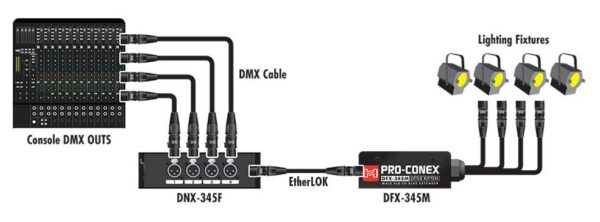
The Four-Universe DMX Trunk
The situation: A lighting designer is running four universes of DMX from the console position to a dimmer rack or distribution node at the other side of the venue. That’s four separate XLR or 5-pin DMX runs — four cables to route, four connectors on the back of the rack to secure, and four places for vibration from the PA or the room to work a connection loose over the course of a long show.
The setup: The DNX-345 — built to AES3 and DMX standards with 110-ohm impedance compliance — handles this correctly. Two DNX boxes, one EtherLOK Cat6 trunk. All four universes travel together through a single locking connection. The DNX’s locking RJ45 chassis connector on the trunk means vibration doesn’t work it free mid-show the way a standard XLR on a truss connection sometimes will.
The payoff: A simpler, more reliable DMX trunk. The 110-ohm spec is not a marketing claim — it’s the reason the DNX, not the LittleCat, is the right tool when digital compliance matters.
Console DMX Outs → Hosa DMX Cables → DNX-345F → 1 EtherLOK Cat6 → DNX-345M → Fixtures
Scenario 04
The Studio or Facility Interconnect — Patching Between Rooms
The situation: A recording studio, broadcast facility, school, or house of worship has shielded Cat infrastructure already installed between rooms — live room to control room, stage to booth, classroom to AV closet. That infrastructure was installed for networking or AV distribution, but it works equally well as a physical transport for analog audio when the right interface is on each end.
The setup: A DFX-345F in the live room or on stage. A DFX-345M in the control room or AV rack. The existing shielded in-wall Cat run connects them. Four balanced channels move between rooms through infrastructure that’s already terminated, already routed, and already there — without running new cable under doors or through hallways.
The payoff: This is where the Pro-Conex system pays for itself quickly on a systems integration job. Existing shielded Cat runs are common in modern construction. Using them for audio eliminates both the labor cost and the material cost of pulling dedicated audio lines — and it does so with a passive, no-configuration interface that any tech on the crew can troubleshoot.
Live Room / Stage → DFX-345F → Existing Shielded Wall Port → EtherLOK Cat6 → DFX-345M → Control Room Rack / DSP
Box vs. Breakout: Which One Do You Need?
The LittleCat and DNX Series solve different problems. Here’s the fastest way to figure out which belongs in your kit.
| Feature | LittleCat (DFX-345) | Extender Box (DNX-345) |
|---|---|---|
| Best For | Racks, table cubbies, direct-to-gear connections | Stage floors, lighting trusses, fixed drop-box positions |
| Signal Type | Analog audio optimized | Analog, AES3, and DMX compliant (110-ohm) |
| Fan-out | Built-in 12″ integrated whip — no patch cables needed | Modular — requires XLR cables on the fan-out side |
| Housing | Galvanized steel with integrated strain relief | Galvanized steel — built for stage floor and truss use |
| Phantom Power | Supported (shielded STP cable required) | Supported (shielded STP cable required) |
| Mixed Use | DNX on stage floor + LittleCat in rack = one EtherLOK trunk, right tool at each end | |
The Pro-Conex Ecosystem
The LittleCat, DNX Series, and EtherLOK are part of a broader Pro-Conex toolkit covering the full signal chain — from source to system. The complete line includes:
|
Direct Boxes
Bridge unbalanced instruments into a balanced signal chain cleanly. Active options for high-impedance sources and long runs.
|
Signal Routing
Fixed and portable stage boxes for consolidating channel counts at the source, including the LittleCat and DNX Series.
|
|
Power
Ruggedized stage-floor extension and power distribution built for production environments.
|
Tools & Accessories
Cable testers, work gloves, and deployment tools designed for the demands of load-in and strike.
|

